About
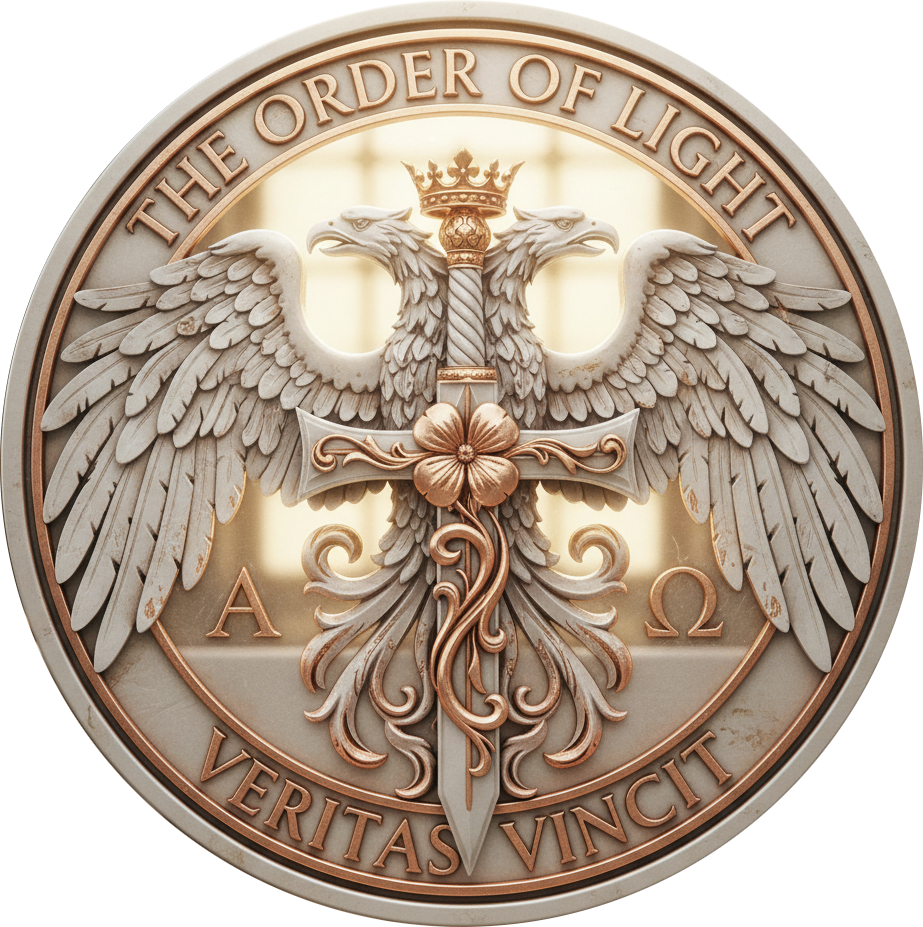
Of the Eternal Brotherhood
The Order of Light is a Confessional Anglican fraternal order whose soteriological heart is union with Christ. It embraces a union-centered soteriology and follows Davenant's hypothetical universalist position on the extent of the atonement. The Order of Light is creedal and confessional, upholding the orthodoxy of the ancient church while also embracing the Reformation's doctrinal reforms.
King James I—who commissioned the most influential English Bible in history—was a Confessional Anglican standing firmly in the English Reformed evangelical tradition, who personally appointed John Davenant to the English delegation at the Synod of Dort in 1618–19, where Davenant articulated and defended a hypothetical universalist position, and who later appointed him Bishop of Salisbury in 1621—the very position the Order of Light now holds. The King's own devotional writing, in the Basilikon Doron of 1599, describes faith as the golden chain that links the faithful soul to Christ—union with Christ language at the heart of the tradition the Order retrieves. The Order of Light does not depart from this historic Anglican inheritance. It recovers it.
Theological Summary
- Ecclesial identity
- Soteriology
- Anthropology
- Eschatology
- Pneumatology
- General
- King James I–Davenant AnglicanismJacobean Anglican Orthodoxy
- Creedal and confessionalNicene • Apostles • Athanasian • 39 Articles • Heidelberg
- Hypothetical universalist (Davenantian)“Sufficiens pro omnibus, efficax pro electis” (Lombardian)Augustine • Prosper • Fulgentius • Lombard • Aquinas
- Union with Christ (Cyrillian & Hooker-Davenantian)Sacramental and mystical incorporation (Cyrillian)Imputed and inherent righteousness (Hooker-Davenantian)Irenaeus • Athanasius • Cyril of Alexandria • Richard Hooker • John Davenant
- Theological compatibilistAugustine • Boethius • Aquinas • Leibniz
- Historic premillennialist (chiliasm)Papias (hearer of John and a companion of Polycarp)Justin Martyr • Irenaeus • Tertullian • Hippolytus • Lactantius
- Cautious continuationist (two-tier)Apostolic office ceased; charismata weighed (1 Cor. 14:29)
- Theologically conservativeReformed Episcopal Church (REC)
Confessional Standards
Ecumenical Creeds
- Nicene Creed (A.D. 381)
- Apostles’ Creed (A.D. 650)
- The Athanasian Creed (A.D. 800)
Foundational Documents
- Thirty-Nine Articles of Religion (1562) — Primary confessional anchor.
- Declaration of Principles (1873) — Explains the Reformed Anglican distinctives and explicitly rejects sacramental regeneration, including the error that regeneration is inseparably connected with Baptism.
Reformed Confessions
- Heidelberg Catechism (1563) — Union with Christ centered devotional and doctrinal standard; of such genuine Protestant breadth that even Jacobus Arminius subscribed to it, demonstrating its character as common ground for all seriously Reformed and evangelical Christians.
- New Hampshire Confession (1833) — A confession rejecting both hyper-Calvinism and Free Will Baptist positions; cited as a theological expression in the Edwardsean tradition.
Liturgical
- REC Book of Common Prayer (Traditional Language) — Confessional use.
- REC Book of Common Prayer (Modern Language) — Practical use.
- A Tenebrae Service — Holy Week observance befitting the order’s theological emphases.
Primary, Secondary, and Tertiary Resources
Primary Sources — Scripture
Note: Study Bible editions are listed here for their textual content. Their commentary apparatus constitutes secondary source material. The NET Full Notes Edition is exceptional in that it spans all three categories—primary (biblical text), secondary (exegetical and translational commentary), and tertiary (text-critical and linguistic annotation).
- ESV Study Bible — Primary recommendation for comprehensive Bible study.
- NIV Biblical Theology Study Bible (ed. D.A. Carson) — Canonical and biblical theology focused.
- NET Full Notes Edition — An unparalleled treasure trove of textual criticism from world-renowned scholars; non-sectarian and inter-denominational.
- NLT Filament Compact — Recommended for pure leisure reading and maximal reading comprehension.
Secondary Sources — Scholarly and Academic Works
Confessional Anglican
- J.C. Ryle (BA, Christ Church, Oxford; Bishop of Liverpool)
- Holiness
- John Davenant (Lady Margaret’s Professor of Divinity, Cambridge)
- De Morte Christi / A Dissertation on the Death of Christ — Foundational Reformed hypothetical-universalist treatise on the death of Christ; a major historical witness within the Anglican and broader Reformed tradition.
- Alister E. McGrath (PhD, Molecular Biophysics, Oxford; DD, Theology, Oxford; DLitt, Intellectual History, Oxford)
- Mere Apologetics
- The Dawkins Delusion
Broadly Evangelical Anglican (Broad-Church / Central, creedal)
- C.S. Lewis (Oxford; Professor at Oxford & Cambridge)
- Mere Christianity
- John C. Polkinghorne (PhD, Quantum Field Theory, Cambridge; PhD, Theoretical Elementary Particle Physics, Trinity College; Professor of Mathematical Physics, Cambridge)
- Quarks, Chaos & Christianity (Note: included for science-faith integration)
Moderately Reformed Evangelical
- D.A. Carson (PhD, University of Cambridge)
- Divine Sovereignty and Human Responsibility — A major evangelical treatment of theological compatibilism, carefully arguing that God’s sovereign rule and genuine human responsibility are fully compatible without collapsing into fatalism or denying meaningful moral agency.
- The Gospel According to John
- The Difficult Doctrine of the Love of God
- Bruce Demarest (PhD, University of Manchester)
- The Cross and Salvation — Comprehensive soteriology affirming universal atonement provision with particular application; the closest available contemporary systematic treatment to the order’s Union-Centered hypothetical universalist position.
- Hugh Ross (PhD, Astrophysics, University of Toronto)
- Beyond the Cosmos — A science-informed apologetic exploring how God’s transdimensional existence helps reconcile divine sovereignty with genuine human freedom, offering an indirect but suggestive model for theological compatibilist accounts.
- Ron Rhodes (ThD, Dallas Theological Seminary)
- The Extent of the Atonement (Note: included for 4-point apologetics value only)
Tertiary Sources — Critical and Linguistic Tools
- BDAG and HALOT Lexicons — The world’s most authoritative Greek and Hebrew lexicons
- A Textual Commentary on the Greek New Testament (Bruce M. Metzger, UBS4) — Essential for textual decisions and variant analysis.
- NET Full Notes Edition — An unparalleled treasure trove of textual criticism from world-renowned scholars; non-sectarian and inter-denominational.
- Daniel B. Wallace (PhD, Dallas Theological Seminary)
- The Basics of New Testament Syntax — Concise companion/overview of the larger grammar.
- Greek Grammar Beyond the Basics: An Exegetical Syntax of the New Testament — Core intermediate Greek syntax reference.
- A Workbook for New Testament Syntax (with Grant Edwards) — Guided practice companion.
- ESV Reverse Interlinear — Essential for mapping English translations back to original languages.
- KJV Parallel Bible (kjvparallelbible.org) — Digital resource for comparative textual criticism.
Contact
Ordo Luminis Fraternitatis Aeternae