How to Have Full Assurance Without False Assurance and Why the Bible Doesn't Teach a Dead or Blind Faith
The question of assurance is one of the most pastorally urgent questions in Christian life. It is also one of the most frequently distorted—in two opposite directions simultaneously. On one side stands the error of false assurance: telling people they are saved when the evidence of their lives gives no warrant for that conclusion. On the other side stands the error of no assurance: leaving genuinely regenerate believers in perpetual doubt about their standing before God. The Order of Light holds that both errors are spiritually dangerous, and that Scripture provides a clear, coherent, and pastorally sufficient answer to both.
That answer is grounded in the Union-Centered tradition—represented in the Anglican stream by Cranmer and Davenant, developed by Edwards and the broader Puritan heritage, and enshrined in the confessional standards the Order of Light upholds—which holds that forensic justification is not the endpoint of salvation but its necessary ground, and that union with Christ is the soteriological heart from which all benefits freely and necessarily flow. We are not only declared righteous—through union with Christ, we are being made righteous by the Spirit's transforming presence, as the free and necessary fruit of a justification already complete and irrevocable. It is precisely this framework that makes genuine, full, and honest assurance possible.
Note: Necessary fruit in Reformed Scholasticism is carefully defined as Necessitas Praesentiae (necessity of presence) rather than Necessitas Efficientiae (necessity of causing).
I. The Problem: False Assurance and Its Consequences
The Free Grace movement—an 80s version of the gospel known as Chaferanism—in its various expressions, has produced a specific and well-documented pastoral crisis. As Dr. Wayne Grudem (2016), Cambridge-educated research professor, warns that this movement abuses and twists God's precious grace into a license to sin, thereby giving "false assurance of eternal life to many people who profess faith in Christ but then show no evidence in their pattern of life" (p. 77); Dr. Daniel B. Wallace, Senior Research Professor of New Testament Studies, Dallas Theological Seminary, labels the movement as "deeply flawed" (Wallace, in Grudem, 2016); J. I. Packer, Oxford-educated Board of Governors' Professor of Theology at Regent College and named one of Time magazine's top 25 evangelicals, calls it "unbiblical, anti-evangelical, and sub-Christian" (Packer, in Grudem, 2016); and Bruce A. Ware, T. Rupert and Lucille Coleman Professor of Christian Theology at The Southern Baptist Theological Seminary, argues that careful biblical and historical argumentation is needed to show "where the Free Grace view has gone wrong" (Ware, in Grudem, 2016).
The mechanism of this error is precise. A person hears that Jesus died for their sins, intellectually assents to this fact as historically true, and is then told by a Free Grace pastor or teacher that they are saved—forever, unconditionally, regardless of any subsequent pattern of life. Grudem describes the pastoral consequence with precision:
If you ask them if they are sinners in need of salvation, they will agree. If you ask them if they believe that Jesus died to pay the penalty for their sins, they will agree. They heard that teaching in a church one time and decided that they thought it was true. They “changed their minds” about sin and about Christ and about their need for salvation. Intellectually they believed those things to be true facts about history and about themselves, and on this basis some Free Grace pastors and teachers have assured them that they are saved.
But they have never truly repented from their sins. They are still lacking a necessary component of genuine saving faith, according to frequent and repeated New Testament presentations. They still lack genuine repentance, and so they have never had genuine New Testament faith. They are not born again. They are lost because of a weakened gospel message.
Such people often wonder what is wrong with their Christian lives. Why do they not have the joy that they see in Christians around them? Why does the Bible never seem to make much sense? Why is prayer not very meaningful? (Grudem, 2016, p. 78).
The tragedy is not merely intellectual error but eternal consequence. People who have been given false assurance are not inoculated against the gospel—they are made resistant to it. They have already been told they are saved. The warning passages of the New Testament, written precisely for people in this condition, no longer reach them. They have been vaccinated with a weakened form of the gospel and thereby made immune to the real thing.
An Aside on True Repentance by C.S. Lewis, Chuck Smith, and Wayne Grudem
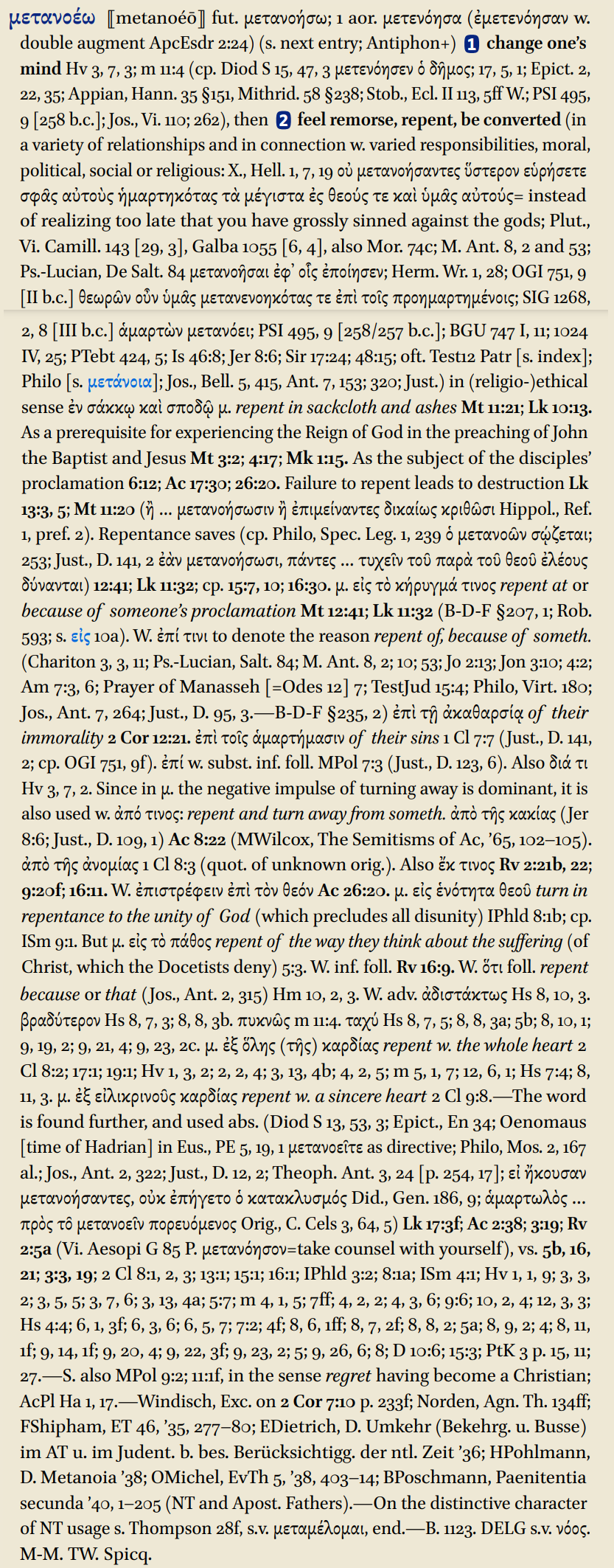
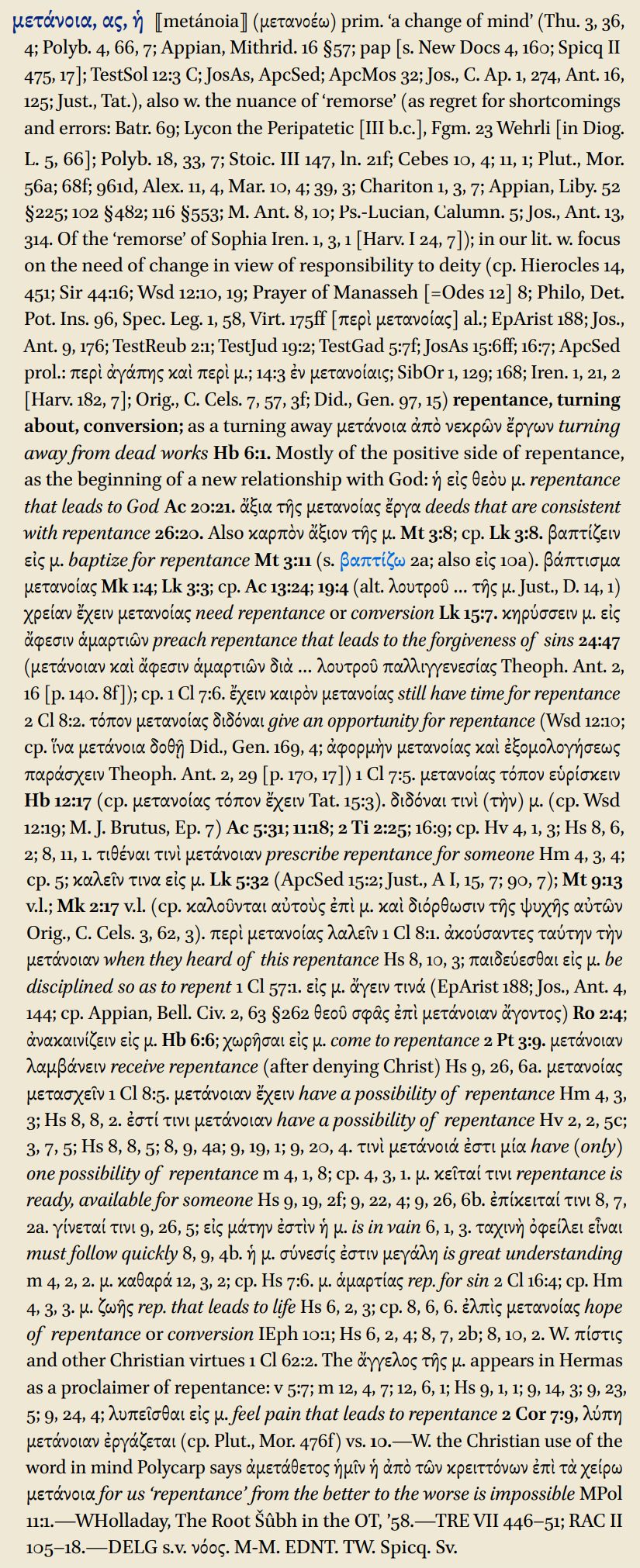
Repentance is not merely mental assent or a change of mind, as the antinomians teach. Christ never applied that pagan sense in Koine Greek, nor do any authoritative lexicons of Biblical Koine Greek apply that definition. The true applied meaning of repent metanoéō falls under the second meaning of “feel remorse, repent, be converted in a (religio-)ethical sense” and repentance metánoia also falls under the second meaning of “repentance, turning about, conversion” as taught by Christ and the Apostles. As Pastor Chuck Smith, articulated (Smith is being cited from archival posthumous uploads):
You can say that you are sorry for what you have done but if you continue to do it, that is not true repentance. Real repentance is being so sorry, so contrite, that you do not do it again. You turn away from it and cease doing it. If a person declares that they have repented of a certain action or sin, and they continue in that same action, there is good reason to doubt the genuineness of the repentance. It is not a true repentance when you continue in that sin. Repentance is the first step to salvation (2015b, 2:10-3:12).
Repentance is defined as "a heartfelt sorrow for sin, a renouncing of it, and a sincere commitment to forsake it and walk in obedience to Christ" Therefore, "Free Grace theology weakens the gospel message by avoiding any call to unbelievers to repent of their sins" (Grudem, 2016, pp. 41-42):
Many understand repentance to mean simply a “change of mind.” The weakness of this position is that, for the New Testament, this meaning finds no support in any authoritative Greek lexicon or in any modern English translation, none of which translate the Greek terms metanoeō and metanoia as “change your mind” for New Testament passages. It is a definition unique to Free Grace supporters, without scholarly support from the academic community or any standard Greek reference works. It also lacks support from any English translation of the Bible (Grudem, 2016, p. 70).
I need to add a word of clarification at this point. While I believe that repentance from sin is a necessary part of saving faith, and while I believe that repentance must include a sincere resolve to turn from one’s sins and begin to obey Christ, I do not think it is accurate to say that saving faith therefore must include obedience to Christ. I believe that saving faith will result in obedience, and saving faith will include a sincere resolve to turn from sin and to begin a new pattern of obedience, but a resolve to turn from sin and begin obedience is not the same as obedience itself. And we must guard jealously the fact that faith alone is what saves us, not faith plus obedience. (Grudem, 2016, pp. 70-71).
A final word from C. S. Lewis, Professor at the University of Oxford, in an excerpt from “The Perfect Penitent” in his book Mere Christianity:
… Now what was the sort of “hole” man had got himself into? He had tried to set up on his own, to behave as if he belonged to himself. In other words, fallen man is not simply an imperfect creature who needs improvement: he is a rebel who must lay down his arms. Laying down your arms, surrendering, saying you are sorry, realising that you have been on the wrong track and getting ready to start life over again from the ground floor—that is the only way out of a “hole.” This process of surrender—this movement full speed astern—is what Christians call repentance. Now repentance is no fun at all.
It is something much harder than merely eating humble pie. It means unlearning all the self-conceit and self-will that we have been training ourselves into for thousands of years. It means killing part of yourself, undergoing a kind of death. In fact, it needs a good man to repent. And here comes the catch. Only a bad person needs to repent: only a good person can repent perfectly. The worse you are the more you need it and the less you can do it. The only person who could do it perfectly would be a perfect person—and he would not need it.
Remember, this repentance, this willing submission to humiliation and a kind of death, is not something God demands of you before He will take you back and which He could let you off if He chose: it is simply a description of what going back to Him is like. If you ask God to take you back without it, you are really asking Him to let you go back without going back. It cannot happen. Very well, then, we must go through with it. But the same badness which makes us need it, makes us unable to do it. Can we do it if God helps us? Yes, but what do we mean when we talk of God helping us? We mean God putting into us a bit of Himself, so to speak. He lends us a little of His reasoning powers and that is how we think: He puts a little of His love into us and that is how we love one another. When you teach a child writing, you hold its hand while it forms the letters: that is, it forms the letters because you are forming them. We love and reason because God loves and reasons and holds our hand while we do it.
II. The Category Mistake at the Heart of Free Grace Assurance
Grudem identifies the precise logical error underlying the Free Grace doctrine of assurance:
This entire line of argument about assurance involves a fundamental category mistake. All Protestant theologians would agree that our assurance that Christ’s work has earned salvation for sinners and that all who trust in Christ will be saved should be based fully and entirely on the testimony of God in Scripture and what Scripture teaches us about the finished atoning work of Christ. But that is not the question here. The question is not: “How do I know that Christ has died for people’s sins?” The question is: “How do I know that I have truly believed?” (Grudem, 2016, pp. 84-85).
Reading Bible verses about the atoning work of Christ tells a person nothing about whether they have genuinely believed. The Free Grace movement conflates two entirely distinct questions—the objective ground of salvation and the subjective evidence of genuine faith—and by answering only the first, leaves the second entirely unaddressed. They offer verses about what Christ has done as answers to questions about what the Spirit has produced in the believer. This is not merely unhelpful—it is a category mistake that produces precisely the false assurance the New Testament warns against.
An Aside by D.A. Carson, Charles Ryrie, and Norman Geisler
I cite Ryrie and Geisler only because proponents of the Free Grace movement often invoke their writings to justify errors the authors themselves did not endorse, particularly in the movement’s more extreme forms. Starting with Geisler: Free Grace adherents are, in fact, quoting a moderate Calvinist. Grudem would correct Geisler on wording—replace “proves” with “gives evidence of”—but otherwise the point stands. The following excerpts are from Dr. Norman Geisler’s Systematic Theology, Vol. 3: Sin & Salvation—Chapter 11, “The Assurance of Salvation,” section: “The Biblical Basis of Eternal Security:”
1 John 3:9 John affirmed that “no one who is born of God will continue to sin, because God’s seed remains in him; he cannot go on sinning, because he has been born of God.” This confirms moderate Calvinism’s view of eternal security for two reasons. First, anyone truly born of God cannot persist in evil. If someone does, then he is not born of God. That is, a Christian’s perseverance in avoiding continual, habitual sin is a proof of [“gives evidence of” is more accurate] his salvation
The following excerpts are from Dr. Norman Geisler’s Systematic Theology, Vol. 3: Sin & Salvation—Chapter 16, “The Condition for Salvation,” concluding his discussion on the nature of saving faith:
Since saving faith is an act of trust in and obedience to Jesus Christ regarding the gospel, it is evident from its very essence that saving faith (which involves repentance) will naturally tend to produce good works—a nominal, noncommittal, purely intellectual-type faith will not. Therefore, whereas we are saved by faith alone, saving faith is not alone but is inclined to produce good works.
The following quotations are from Norman Geisler (quoting Charles Ryrie), cited in Pinson (2002), 4 Views on Eternal Security:
While works do not flow automatically from saving faith, they do flow naturally, just as buds come naturally from a live bush. As Charles Ryrie correctly observed, "every Christian will bear fruit; otherwise he or she is not a true believer." For "fruit, then, furnishes evidence of saving faith. The evidence may be strong or weak, erratic or regular, visible or not. But a saving faith works" (Geisler, in Pinson, 2002, p. 105).
As Ryrie put it, "Saving faith is a working faith, and those works justify believers in the courtroom on earth," and an "unproductive faith is a spurious faith." (Geisler, in Pinson, 2002, p. 107).
This Order regards D.A. Carson as the only reliable authority of those named in this section: a Cambridge‑educated scholar and Emeritus Professor of New Testament at Trinity Evangelical Divinity School, praised as “one of the last great Renaissance men in evangelical biblical scholarship” and credited with producing “the most seminal New Testament work by contemporary evangelicals:”
Faith Is More than BeliefBut in the second place, faith is more than simply believing that certain things are true. James has something to say about this in the second chapter of his epistle. He says, “Faith without works is dead.” In fact, a few months ago, I was in Sweden debating with a Catholic theologian who said, “I don’t understand you Christians who call yourselves evangelicals.” He says, “You speak of being saved by faith alone, whereas James explicitly says that ‘Faith without works is dead.’ Faith, all by itself, faith alone, is precisely what’s invalid. How do you respond to that?” My response is pretty straightforward. The kind of faith that James is talking about is not the kind of faith that Paul is talking about. They use the same word in different ways, which often happens in the New Testament.
Let me give you another example so you see I’m not making things up. When Paul says that Christians are “called of God,” for example, for him, the call of God is effectual; it works. If you’re called of God, you really are saved. Whereas, in the Synoptic Gospels (Matthew, Mark, and Luke), the call of God is something like the invitation of God: “Many are called, but few are chosen.” So in other words, the word “call” can mean slightly different things depending on the writer, depending on the context. That often happens. It’s because God has chosen to give His infallible Word through different human functionaries, through human authors.
So how does “faith” mean something different in James than in Paul? Well, James makes it very clear. He says, “Consider the demons. They believe there is one God.” In fact, he says, “You believe there is one God; you’re doing well. But then so do the demons, and it doesn’t save them, so why should it save you?” Satan himself believes that Jesus rose from the dead; he believes in the resurrection, but it doesn’t save him. In other words, merely believing the truth that Christ rose from the dead is not salvific; it’s not saving; it’s not transforming (Carson, n.d., “What Is Faith” section).
Faith Includes TrustThere is another element: faith, though it is based on the truth or on the promises and words of Him who is the truth, faith also involves self-abandonment to that truth or to the God who speaks the truth. It involves our trust in Him. Satan believes that Jesus rose from the dead; Satan never trusts Christ. Satan believes that there is one God; he doesn’t abandon himself to God. Genuine saving faith is not to be confused with works, but it is of a different quality than mere belief in propositions. The propositions must be true (that’s the first point), but in the second place, there must be a self-abandonment to God.
It has a kind of repentance built into it. It’s the very nature of faith to abandon myself to God and His word and His promises, or it’s not saving faith. So when Paul says to the Philippian jailer, “Believe in the Lord Jesus Christ, and you shall be saved,” he certainly means something more than “Believe that Jesus rose from the dead, and you will be saved.” That you might almost call “demonic faith”; that is to say, it’s faith that a demon can exercise without it saving anybody, whereas genuine saving faith not only believes the truth that God has revealed, but also it finds the believer abandoning himself, abandoning herself, to Christ in wonderful trust (Carson, n.d., “What Is Faith” section).
III. What the New Testament Actually Teaches About Assurance
The New Testament epistles were written not to outsiders but to congregations—to people who considered themselves Christians and who would hear these letters read aloud in their churches. And yet the apostolic authors do not hesitate to include warning passages challenging their readers to examine whether they are genuinely saved. This is a remarkable and deliberate pastoral strategy. The warnings are not written to provoke anxiety in the genuinely regenerate but to expose the false assurance of the unregenerate professor.
The biblical criterion for full assurance of salvation is given most clearly in the first epistle of John. According to scholars, a fruitless faith is a superficial faith, and the key in teaching full assurance of salvation is not to give false assurance of salvation. Christ's message of fruit-bearing is the message of assurance and the second part of the sola fide doctrine: justification is by faith alone, but not by faith that is alone. This doctrine correctly teaches fruit-bearing as evidence of genuine faith. If you do not hold to this, you do not hold to sola fide, the Reformation doctrine of faith alone.
And we can be sure that we know him if we obey his commandments. If someone claims, “I know God,” but doesn’t obey God’s commandments, that person is a liar and is not living in the truth. But those who obey God’s word truly show how completely they love him. That is how we know we are living in him. Those who say they live in God should live their lives as Jesus did (New Living Translation, 2015, 1Jn. 2:3-6; cf. Rom. 3:31).
The Apostle John completely destroys any notion of antinomianism when he reveals that true born-again Christians are so changed that they cannot make a practice of sin:
Everyone who makes a practice of sinning also practices lawlessness; sin is lawlessness. You know that he appeared in order to take away sins, and in him there is no sin. No one who abides in him keeps on sinning; no one who keeps on sinning has either seen him or known him. Little children, let no one deceive you. Whoever practices righteousness is righteous, as he is righteous. Whoever makes a practice of sinning is of the devil, for the devil has been sinning from the beginning. The reason the Son of God appeared was to destroy the works of the devil. No one born of God makes a practice of sinning, for God's seed abides in him; and he cannot keep on sinning, because he has been born of God. By this it is evident who are the children of God, and who are the children of the devil: whoever does not practice righteousness is not of God, nor is the one who does not love his brother (ESV Study Bible, 2008, 1 John 3:4-10 ESV).
Additional passages confirm this pattern throughout the canon:
- Verses against legalism: Eph 2:8-10; Gal 2:16,21; 3:10-12; 5:4; Ro 3:20,28
- Verses against antinomianism: 1 Jn 3:6-10; 5:18; Jd 4 NET; Ro 6:1-2,15; 3:8,31; Heb 10:26-31; 6:4-6; Lk 9:62
- Verses for obedience after justification: 1Jn 2:3-6; 3:6-10; 5:3-4; Jn 14:15,21; 15:10; Heb. 5:9
- Verses for Godly dispositions of Love: 1 Jn 2:9-11; 3:10; 4:8,20; Jn 13:34-35
- Verses for Godly and Holy lives: Heb 12:14; 1 Tim 6:3-4; 2 Tim 3:12; Titus 2:11-12; Gal 5:22-23
- Verses for good works after justification: James 2:14-26; Eph 2:10
- The Holy Spirit produces the fruit, not human decision: Ga 5:22-23 NLT; Jn 15:4-5; 1Cor 3:6-7
IV. The Theological Foundation: Why Transformation Is Necessary and Free
The Order of Light's Union-Centered position provides the precise theological framework that explains why genuine assurance is both possible and grounded in observable fruit—without that fruit becoming a new form of legalism.
The key is the ordo salutis—the order of salvation. Regeneration is effected solely by the power of the Holy Spirit, and its proper evidence appears in the holy fruits of repentance, faith, and newness of life. This is not the believer producing fruit through effort—it is the Spirit producing fruit as the inevitable consequence of new birth. Regeneration precedes and produces repentance and faith as its necessary fruits rather than their following them as conditions. The sequence is:
Election → Effectual Calling → Regeneration → Repentance (leads to salvation) and Faith → Justification (Faith) → Sanctification → Glorification
Note: Repentance and faith are not human contributions preceding justification but Spirit-produced fruits of regeneration—two inseparable aspects of the same sovereign work. Saving faith results in obedience; it does not include obedience. The resolve to turn from sin is not the same as the performance of obedience, and neither merits or conditions the justification that follows.
This sequence is theologically decisive for assurance. Because regeneration precedes and produces faith, the believer's assurance does not ultimately rest on the quality or strength of their own faith decision—it rests on God's sovereign regenerative work, of which faith and fruit are the visible evidence. The faith that justifies, Luther said, is a fides viva—a living faith, a faith that is alive—and you know it is alive when it manifests itself in the fruit of obedience.
Furthermore, because transformation is Spirit-produced rather than self-generated, it carries no legalist danger. The question is never "how much fruit must I produce to be saved?" The question is "has the Spirit produced any fruit at all?" As Grudem helpfully clarifies:
Therefore, the proper answer to the question, “How many good works does one have to do in order to be assured of salvation?” is, “Some.” To be more specific, some change of life gives a basis for some measure of assurance, and a greater change of life gives a basis for a stronger assurance. Scripture does not encourage us to demand more specificity than that. A simple diagram might help to clarify the question of assurance (see Diagram 3.1).
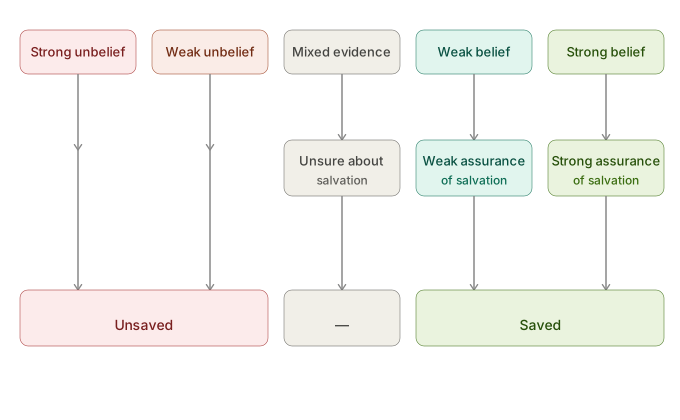
As Diagram 3.1 indicates, the evidence that a person has actually believed in Christ falls along a spectrum from weak to strong. God alone knows with absolute certainty everyone who is saved and everyone who is lost, for “the Lord knows those who are his” (2 Tim. 2:19), but we can perceive stronger or weaker outward indications of what is actually in someone’s heart, both our own hearts and those of others. In the shaded middle of the spectrum, where people give mixed evidence in their profession of faith and in their conduct of life, we simply have to say that we do not know whether the person is saved or not—the evidence is mixed (Grudem, 2016, p. 92)
This is not legalism—it is the diagnostic use of Spirit-produced fruit as evidence of divine regeneration already accomplished. You cannot boast in what the Spirit alone produces. But you can examine it as evidence of what God has done.
V. The Five Propositions of Genuine Assurance
The Order of Light's full soteriological position, developed from the canonical witness, produces the following precise framework for genuine assurance without false assurance:
Proposition 1: Regeneration is effected solely by the power of the Holy Spirit, producing repentance, faith, and newness of life as its necessary and proper evidence. The new birth precedes and produces saving faith—it is not produced by it.
Proposition 2: Justification is by faith alone—but that faith is itself a fruit of regeneration, and the faith that saves is never alone in the person justified.
Proposition 3: Saving faith results in obedience and good works that follow after—not merit—justification. Results in, not includes.
Proposition 4: Obedience does not merit salvation—the Holy Spirit produces obedience as the fruit of regeneration and union with Christ. It is not human effort but Spirit-produced transformation.
Proposition 5: Faith is not a work—repentance and faith are fruits of regeneration, produced by the Spirit alone (Mt 3:8-10 NLT).
VI. Assurance Is Possible—and It Is Full
The historic Protestant position, represented in the Westminster Confession of Faith, teaches precisely this:
Such as truly believe in the Lord Jesus, and love him in sincerity, endeavoring to walk in all good conscience before him, may, in this life, be certainly assured that they are in the state of grace. . . . This certainty is not a bare conjectural and probable persuasion . . . but an infallible assurance of faith founded upon the divine truth of the promises of salvation, the inward evidences of those graces unto which these promises are made, the testimony of the Spirit of adoption witnessing with our spirits that we are the children of God (Westminster Confession 18.1-2).
Full assurance therefore rests on three concurrent grounds, all of which Scripture provides:
1. The objective ground—Christ’s finished atoning work, declared in Scripture, on the basis of which all who genuinely trust in him are saved. This is Davenant’s contribution: the atonement was genuinely provisioned for all, making the gospel offer sincere to every hearer.
2. The subjective ground—The internal testimony of the Holy Spirit bearing witness with our spirit that we are children of God (Rom. 8:16), and the observable fruit of Spirit-worked transformation in our pattern of life.
3. The perseverance ground—We are kept not by our grip on Christ but by his grip on us. “By God’s power are being guarded through faith for a salvation ready to be revealed in the last time” (1 Pet. 1:5).
As Grudem writes: "No one who has such assurance should wonder, 'Will I be able to persevere to the end of my life and therefore be saved?' Everyone who gains assurance through such a self-examination should rather think, 'I am truly born again; therefore, I will certainly persevere to the end, because I'm being guarded by God's power working through my faith.'"
VII. A Warning From Christ and His Faithful
Christ himself warned with the greatest seriousness about those who would give false assurance to others:
Then he said, “I tell you the truth, unless you turn from your sins and become like little children, you will never get into the Kingdom of Heaven. So anyone who becomes as humble as this little child is the greatest in the Kingdom of Heaven. “And anyone who welcomes a little child like this on my behalf is welcoming me. But if you cause one of these little ones who trusts in me to fall into sin, it would be better for you to have a large millstone tied around your neck and be drowned in the depths of the sea (New Living Translation, 2015, Matt. 18:3-6 NLT).
Pastor Chuck Smith stated plainly:
Do not be deceived, if you are walking after the flesh and involved in the things of the flesh, you have no assurance of being in the Kingdom of Heaven (Smith, 2023, 00:00).
If I am living a life of practicing sin, I really don’t know Him. I really haven’t seen Him. If I really know Him, then I’m gonna be free from the practice of sin. ... So again, don’t deceive yourself. If you are practicing sin, living in sin, you are not of God; you are a part of that rebellion against God, led by Satan (Smith, 2015a, 1Jn 3:6-8).
You can say that you are sorry for what you have done but if you continue to do it, that is not true repentance. Real repentance is being so sorry, so contrite, that you do not do it again. You turn away from it and cease doing it. If a person declares that they have repented of a certain action or sin, and they continue in that same action, there is good reason to doubt the genuineness of the repentance. It is not a true repentance when you continue in that sin. Repentance is the first step to salvation (Smith, 2015b, 2:10-3:12).
VIII. Reasoning With the Uncertain
For those who are uncertain about their standing before God, the New Testament's answer is not to manufacture false certainty but to examine honestly:
Examine yourselves to see if your faith is genuine. Test yourselves. ... (New Living Translation, 2015, 2 Cor. 13:5).
This examination is not an invitation to anxiety—it is an invitation to honesty. The Spirit who regenerates also witnesses to that regeneration through the fruit he produces. Those who find genuine love for the brethren, genuine hatred of sin, genuine desire for God's Word, and genuine repentance when they fail—these have strong evidence of genuine regeneration. Those who find none of these things should heed the warning passages rather than claim an assurance the New Testament does not extend to them.
Is the basis of your assurance a living faith or a dead faith? The answer matters eternally. But it is answerable—and that is the good news. You do not have to wonder. The Spirit who saves also testifies. The fruit he produces is visible. And the Christ who justified you also holds you—not the other way around.
Faith without works is dead (Jas. 2:26).
IX. Hope For Those Who Have Fallen
If you have read this far and found yourself in the warnings—if the fruit described in 1 John is absent, if the assurance you have claimed rests on a past decision rather than a living faith—the door is not shut. The same gospel that exposes false assurance also extends a genuine offer. Come with real repentance and real trust in Christ, and you will not only be saved but will know it with full and honest assurance—because the Spirit will produce the fruit that confirms He has done the work in you.
One caution before you respond: do not attempt to make yourself right before coming. The temptation upon reading warnings like these is to begin a self-improvement project—to clean up your life first, produce fruit on your own, and then approach God once you are presentable. This is precisely the error Paul warns against in Galatians 5:4—seeking justification by your own efforts, which severs you from grace rather than securing it. You cannot generate the fruit this article describes. Only the Spirit produces it. Come as you are, with nothing but repentance and trust, and the transformation will follow as His work—not yours.
- True repentance is still possible. Not mere mental regret or “I used to believe that,” but the full turning described by Chuck Smith in the article: being “so sorry, so contrite, that you do not do it again. You turn away from it and cease doing it.” This includes turning from both the sins you once excused and from the unbelief itself.
- Genuine saving faith is still available. Not the intellectual assent the article condemns, but Spirit-produced faith that is “never alone”—it necessarily brings love for God, hatred of sin, love for the brethren, and obedience as fruit.
Regeneration can still happen — the Holy Spirit who produces the new birth has not exhausted his power. The ordo salutis laid out in this article is not an offer that expires. It remains open.
Full assurance can still be yours—but only the real kind, grounded in observable Spirit-wrought transformation rather than a past decision or a pastor’s promise.
Conclusion
The Order of Light commends the Union-Centered soteriological position—held within a Confessional Anglican framework but shared across Reformed evangelical traditions—precisely because it is the only framework that closes both doors simultaneously—the door of false assurance and the door of no assurance. Forensic justification by faith alone provides the objective ground: salvation is entirely God's work, received through Spirit-produced faith, grounded in Christ's finished atonement. Spirit-worked transformation provides the subjective evidence: the fruit that confirms what God has already accomplished. And union with Christ provides the security: the branch cannot be separated from the vine that holds it.
The faith that saves is never alone in the person justified. And the person who is genuinely justified—regenerated by the Spirit, united to Christ, bearing the fruit that the Spirit necessarily produces—may have full assurance. Not false assurance. Full assurance. Veritas Vincit.
- Don Carson (n.d.). Justification by faith: A biblical‑theological perspective. The Gospel Coalition. Retrieved April 2, 2026, from https://www.thegospelcoalition.org/course/justification-faith-biblical-theological-perspective/#what-is-faith
- ESV Study Bible (ESV text ed.). (2008). Crossway.
- Grudem, W. (2016). "Free grace" theology: 5 ways it diminishes the gospel. Crossway.
- New Living Translation (Filament enabled ed.). (2015). Tyndale House Publishers.
- Pinson, J.M. (Ed.). (2002). 4 views on eternal security. Zondervan.
- Smith, C. (2015a, June 1). C2000 series. Calvary Chapel. https://calvarychapel.com/posts/c2000/
- Smith, C. (2015b, December 28). Repentance, Matthew 3:8 [Video]. YouTube. https://youtu.be/kP8rIIps4Sk?t=130
- Smith, C. (2023, November 2). No assurance in the flesh [Video]. YouTube. https://www.youtube.com/shorts/aBG9kH-z8Q8
- Westminster Confession of Faith (Chapter 18). (1647/2021). Free Presbyterian Publications.
Ordo Luminis Fraternitatis Aeternae