The Emblems of the Order of Light
The Emblem of the Order of Light
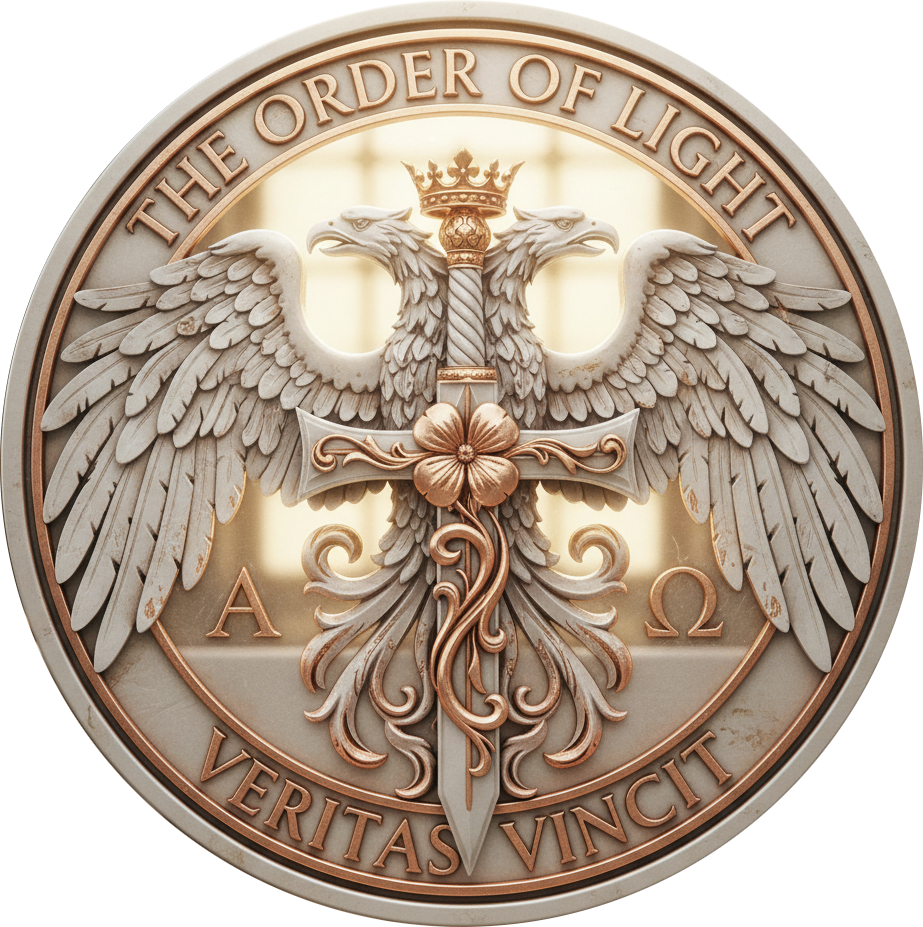
The seal of the Order of Light is a layered composition of symbols, each bearing theological and fraternal significance that together express the order’s identity and mission.
The Cross The cross is the dominant and governing symbol of the seal, integrated with and inseparable from the sword that descends beneath it. It asserts without ambiguity the theological priority of Christ’s atoning work as the foundation upon which everything else in the order’s identity rests. The cross does not merely appear — it penetrates and orders the entire composition, grounding the order’s mission in the historical, substitutionary death that made resurrection possible. Rendered in white gold, it signals purity, costliness, and the incorruptible character of the truth it represents.
The Crown Resting above the cross at the seal’s highest point is a crown — the crown of sovereign victory belonging to the risen Christ. It signals that the order’s mission is not conducted under a defeated or absent king but under the active reign of the ascended Lord who has conquered death and holds all things under his feet. The crown does not belong to the order — it belongs to Christ alone. The order exists beneath it, not beneath its own authority but under his.
The Two-Headed Phoenix Secondary to the cross but expansive in its presence, the two-headed Phoenix spreads its wings in heraldic display behind and beneath it, rendered in white gold to signal purity and resurrection glory. The two heads are theologically deliberate — one gazing toward death, one toward resurrection, together embodying the complete paschal mystery of Christ who passed through death and emerged gloriously alive. The two heads mirror the Alpha and Omega flanking the composition below — the first and the last, the beginning and the end. The Phoenix simultaneously evokes the pelican in piety, the classical Christian symbol of Christ’s self-giving sacrifice — both readings coexist intentionally, holding together the two movements of salvation: death poured out and life restored. The Phoenix is the order’s governing image of transformation precisely because resurrection is not merely a future hope but the present reality into which every member has been drawn through union with Christ — dying with him, rising with him, transformed by him. The spread wings signal that this resurrection life is triumphant and impossible to suppress — as Veritas Vincit declares, what is true cannot ultimately be extinguished.
The Rose At the crossguard where the cross meets the sword blooms a rose gold flower — the rose, one of Christianity’s most ancient symbols of martyrdom, sacrificial love, and the wounds of Christ. Its placement at the intersection of cross and sword is deliberate — it is precisely at the point of cost and sacrifice that love is most fully expressed. The rose gold material distinguishes it from the white gold of the cross and Phoenix, signaling warmth, blood, and the sacrificial love that grounds the order’s entire theological vision. It is the visible heart of the emblem — love at the center of truth.
The Sword Descending from the cross, the sword points downward through the composition. It represents the Word of God as the sword of the Spirit — drawn from Ephesians 6 — signifying that the order’s mission is pursued not with physical force but with truth, reason, and faithful proclamation, in the conviction that truth is always worth defending at cost. The downward orientation signals humility and submission to God’s Word rather than aggression.
The Sacred Fire At the base of the blade, rose gold flames of sacred fire engulf the sword — the Spirit-animated Word made visible. John the Baptist declared that Christ would baptize with the Holy Spirit and with fire, and the tongues of flame at Pentecost established fire as the Spirit’s own sign. Paul’s Ephesians 6 designation of the Word as the sword of the Spirit — specifically rhema, the Spirit-carried living utterance rather than mere written text — means the fire does not merely accompany the blade but animates it entirely, signaling that the order’s proclamation of truth is not cold human argument but Spirit-breathed, Spirit-applied, and Spirit-carried into the hearts of those who hear it. As the seraph’s coal purified Isaiah’s lips for prophetic mission, the sacred fire on the blade speaks simultaneously of purification and consecration — the order’s witness set apart, refined, and made holy by the same Spirit whose fire it bears. The rose gold of the flames matches the rose at the crossguard precisely — Spirit and sacrificial love rendered in the same precious metal, inseparable in the order’s theological vision.
Alpha and Omega Flanking the composition are the Greek letters Alpha and Omega — drawn from Revelation’s declaration that Christ is the beginning and the end. They echo the two-headed Phoenix above them, reinforcing the order’s conviction that Christ encompasses all of history and all of salvation within himself — from first to last, from death to resurrection, from darkness to light.
The Sanctuary Light The luminous glow emanating from behind the entire composition is not decorative but theological. The Order of Light takes its name seriously — Christ is the light of the world (John 8:12), and those united to him are called to be the light of the world (Matthew 5:14). The warm sanctuary glow signals that the order’s mission is conducted not in the harsh light of polemical combat but in the warm, welcoming light of truth graciously offered — a sanctuary of theological seriousness open to all who seek it.
Veritas Vincit The motto at the base — Truth Conquers — drawn from the Hussite tradition, declares the order’s foundational conviction: that truth, however contested, ultimately prevails. Like the Phoenix itself, truth cannot be burned out. It is simultaneously a theological claim and a fraternal challenge to every member.
The Color Register White gold throughout signals purity, incorruptibility, and resurrection glory — the Phoenix, the cross, and the sword rendered in the most precious and untarnishable of metals. Rose gold on the sacred fire, the flower, and the filigree distinguishes the elements of sacrificial love, Spirit-animation, and warmth — the active, living, and costly dimensions of the order’s mission. The worn and aged quality of both metals signals that this is not a new institution but the retrieval of something ancient, tested, and permanent.
Ordo Luminis Fraternitatis Aeternae